
Flood Insurance · Western Wisconsin · Coulee Region
Flood Insurance in Wisconsin: The 30-Day Wait
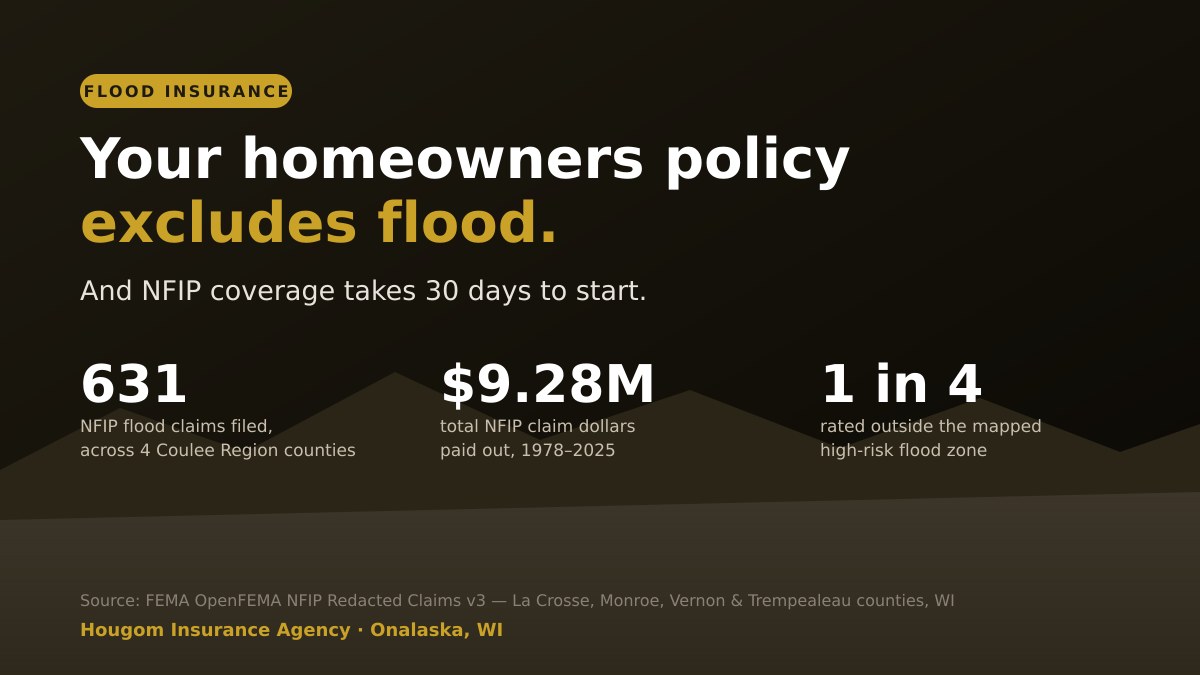
A standard Wisconsin homeowners policy does not cover flood damage — not in the Coulee Region, not anywhere, and not as an oversight. Flood is a separately purchased coverage, and under 44 CFR § 61.11(d) a new federal flood policy does not take effect until 12:01 a.m. on the 30th calendar day after you apply and pay. That single rule is why this is a decision you make in October and not in March. FEMA's own claim records for La Crosse, Monroe, Vernon and Trempealeau counties show 631 flood claims and $9.28 million paid since 1978 — and roughly one in four of those claims came from a property rated outside the mapped high-risk flood zone.
TL;DR — Key takeaways
- Homeowners excludes flood. Water that rises off the ground and comes in from outside is a flood claim. Water from your roof or your plumbing is a homeowners claim. Sewer backup is a third thing again.
- There is a 30-day waiting period. Under 44 CFR § 61.11, with only three narrow exceptions — a loan closing, a newly revised flood map, and post-wildfire flooding on federal land.
- NFIP coverage is capped. 44 CFR § 61.6 caps a single-family home at $250,000 building and $100,000 contents. Above that, you need private flood coverage.
- One in four local claims was outside the high-risk zone. 149 of 603 zoned NFIP claims across the four counties were rated in zone B, C or X — $2.62 million of the $9.28 million paid.
- Your lender decides, if you're in a mapped high-risk area. 42 U.S.C. § 4012a(b)(1) requires it as a condition of the loan — and requires lenders to accept qualifying private flood insurance too.
- Disaster aid is not a backup plan. La Crosse County had NFIP flood losses in 32 separate years since 1978, but only 11 of those years brought a federal flood declaration — and assistance, when it comes, caps at $44,800 per household for housing.
- Basements and land are largely excluded even on a flood policy, and the NFIP residential policy has no loss-of-use coverage.
Why does your homeowners policy exclude flood?
Not because an underwriter was careless. Flood is excluded from standard homeowners forms because it behaves differently from almost every other peril a home policy covers.
Most insured perils are scattered. A kitchen fire happens to one house on a block; a hailstorm damages some roofs and spares others; a burst pipe is nobody's problem but yours. The arithmetic of insurance depends on that scattering — many people paying premiums, a few of them claiming in any given year. Flood does not scatter. When the Mississippi comes up, or when a Coulee Region creek takes a July downpour it cannot carry, it does not pick one house out of a neighborhood. It reaches every structure below a certain elevation at more or less the same hour. Insurers call that correlated risk, and a standard homeowners book cannot absorb it.
That is why Congress created the National Flood Insurance Program in 1968, and why flood coverage is bought as its own policy — either from the NFIP through a licensed agent, or from a private flood carrier. It is not an endorsement you can tack on in most cases, and it is not hiding somewhere in your homeowners declarations page. If you have never specifically bought it, you do not have it.
The short version. Your homeowners policy covers the water that falls on your house. It does not cover the water that rises up to meet it.
What actually counts as a "flood"?
This matters more than people expect, because after a bad storm a homeowner often has damage from two or three different causes at once, and which policy responds depends entirely on which category the water falls into.
The federal definition is specific. Under 44 CFR § 59.1, flood or flooding means "a general and temporary condition of partial or complete inundation of normally dry land areas from" the overflow of inland or tidal waters, "the unusual and rapid accumulation or runoff of surface waters from any source," or mudslides — mudflows — "proximately caused by flooding" of that second kind "and are akin to a river of liquid and flowing mud on the surfaces of normally dry land areas." A second branch of the definition covers the collapse or subsidence of land along a shoreline caused by erosion or an abnormal water level.
Read that second clause again, because it is the one western Wisconsin homeowners underestimate: "the unusual and rapid accumulation or runoff of surface waters from any source." You do not need a river. A hillside above a Coulee Region subdivision shedding four inches of rain in ninety minutes produces exactly that, and the resulting damage is a flood claim even if the nearest named waterway is three miles away and never left its banks.
| What happened | Generally covered by | Notes |
|---|---|---|
| Rain comes through a wind-damaged roof | Homeowners policy | The water entered from above after a covered peril opened the building. Not a flood. |
| A supply line or water heater fails inside | Homeowners policy | Sudden and accidental discharge from a plumbing system. Gradual seepage is usually excluded. |
| A river, creek or coulee overtops and enters the building | Flood policy | Overflow of inland waters — squarely within the 44 CFR § 59.1 definition. |
| Heavy rain runs off a hillside and in through the door | Flood policy | "Unusual and rapid accumulation or runoff of surface waters from any source." No river required. |
| The municipal sewer backs up into the basement | Sewer/water backup endorsement | Usually neither a base homeowners claim nor a flood claim. It is a specific endorsement you have to ask for. |
| Groundwater seeps through a foundation wall | Often nothing | Commonly excluded on both forms. This is the gap that surprises people most. |
| Your parked car is flooded | Auto policy — comprehensive | Vehicles are never covered by a flood policy or a homeowners policy. |
General guidance only. Policy forms differ between carriers and between the NFIP's own policy forms; your declarations page and policy language control. Confirm your specific coverage with a licensed agent.
The 30-day waiting period, and its three exceptions
This is the rule that decides whether reading this article in October was worth anything.
44 CFR § 61.11(d) sets the default: the effective date and time of any new policy, added coverage, or increase in coverage is "12:01 a.m. (local time) on the 30th calendar day after the application date and the presentment of payment of premium." The regulation supplies its own example — "a flood insurance policy applied for with the payment of the premium on May 1 will become effective at 12:01 a.m. on May 31."
Thirty days. Not thirty days from when you called, or from when you thought about it. And note subsection (f) while you are there: payment to an agent "does not constitute payment to the NFIP," so the clock runs from when the application and premium actually reach the program.
There are exactly three ways out of the 30 days, and none of them is a weather forecast.
| Situation | Coverage begins | Authority |
|---|---|---|
| Ordinary new purchase — you decide you want flood coverage | 12:01 a.m. on the 30th calendar day after application and premium payment | § 61.11(d) |
| Bought in connection with a loan — making, increasing, extending or renewing | At the time of the loan closing, if applied and paid for at or before closing | § 61.11(b) |
| Within 13 months of a revised flood map for your community | 12:01 a.m. the first calendar day after application and premium payment | § 61.11(a) |
| Post-wildfire flooding on federal land, bought within 60 days of fire containment | 12:01 a.m. the first calendar day after application and premium payment | § 61.11(c) |
Source: 44 CFR § 61.11, read in full on eCFR, October 12, 2026. Subsection (e) permits adding or increasing coverage mid-term, but that too is "subject to any applicable waiting periods."
Why October, and not March. Wisconsin's flood season is driven by snowmelt and spring rain on ground that is still frozen or already saturated. By the time a crest forecast is on the news, the 30-day window has closed on anyone who waited. If you buy coverage on March 15 because the forecast turned, you are insured from April 14 — for next year's flood, not this one.
What the NFIP will — and won't — pay
Federal flood coverage is capped by regulation, and the caps have not moved in years. 44 CFR § 61.6 publishes them in a table, by occupancy type, for the Regular Program that most participating communities are in.
| Occupancy | Building coverage | Contents coverage |
|---|---|---|
| Single-family dwelling | $250,000 | $100,000 |
| Two-to-four family building | $250,000 | $100,000 |
| Other residential, incl. multifamily | $500,000 | $100,000 |
| Residential condominium building | $250,000 × number of units | $100,000 |
| Non-residential building | $500,000 | $500,000 |
Source: 44 CFR § 61.6, Table 1 to Paragraph (a), Regular Program column. Contents limits are per the Residential Property and Non-Residential Property rows of the same table. A community still in the NFIP's Emergency Program has much lower limits — $35,000 of building coverage on a single-family dwelling and $10,000 of residential contents.
Three things about that table change how you should read it.
- Building and contents are separate purchases. Buying one does not give you the other. A renter can buy contents coverage alone; a landlord who insures the building has not insured a tenant's belongings.
- These are ceilings, not entitlements. You can buy less, and an NFIP policy pays the loss subject to your limits, your deductible, and the policy's valuation rules — replacement cost in some circumstances, actual cash value in others.
- Above the cap, you are on your own unless you go private. A $600,000 home with a $250,000 NFIP building limit has $350,000 of uninsured exposure. Private flood carriers exist to write above that line, and in many cases to write it alongside an NFIP policy.
What a flood policy generally does not cover
The exclusions catch people out more often than the limits do, because they are counterintuitive if your mental model is a homeowners policy.
- Land, landscaping and most outdoor property. Decks, patios, fences, septic systems, wells, hot tubs and swimming pools are generally outside what a Standard Flood Insurance Policy pays for — as is the land itself, which is often the most expensive thing a flood damages.
- Most of what is in your basement. Basement coverage is sharply restricted. Certain appliances and utility equipment are addressed, but finished basement walls, flooring, furniture and personal belongings are generally not covered the way the same items would be on the floor above. In a region where the finished basement is a standard feature, this is the single most important sentence in this article for a lot of households.
- Loss of use. The NFIP residential policy does not pay additional living expenses while you are out of the house. Your homeowners policy would have, for a covered homeowners loss. For a flood, it does not.
- Vehicles. A flooded car is a comprehensive auto claim, not a flood-policy claim.
Policy forms differ, and the NFIP has more than one. Read your own declarations page, and ask specifically about the basement before you assume.
One in four local flood claims came from outside the flood zone
The most common reason people here skip flood coverage is that a lender never required it. That reasoning treats the Flood Insurance Rate Map as a prediction. It is not one — it is a regulatory boundary, drawn with a specific purpose, and water has never been asked to respect it.
We pulled every NFIP claim record FEMA publishes for the four counties we write the most property in — La Crosse, Monroe, Vernon and Trempealeau — from the agency's OpenFEMA NFIP Redacted Claims dataset. There are 631 claims in it, with loss years from 1978 through 2025, and $9,282,580 paid out across building and contents.
Of the 603 of those claims that record the flood zone the policy was rated in, 149 — 24.7 percent — were rated in zone B, C or X. Those are the zones outside the Special Flood Hazard Area: the areas where no lender requires coverage and where most owners assume they do not need it. Those 149 claims account for $2,622,149 of the money paid.
Share of NFIP claims rated outside the high-risk flood zone, by county
Source: FEMA, OpenFEMA NFIP Redacted Claims v3, queried October 12, 2026 by county FIPS code. Share is claims whose recorded rated flood zone is B, C or X, as a percentage of claims in that county with any rated flood zone recorded (Vernon 59 of 170; Monroe 30 of 89; La Crosse 38 of 203; Trempealeau 22 of 141). Zone is the one used to rate the policy, which can differ from a property's current mapped zone.
The county-by-county spread is itself worth sitting with. In Vernon and Monroe counties, more than a third of flood claims came from properties rated outside the high-risk zone — this is coulee country, where the water that does the damage is often runoff off a ridge rather than a river leaving its channel, and where the mapped Special Flood Hazard Area follows the valley floors.
| County | Claims on record | Total paid | Average paid claim | Rated outside high-risk zone |
|---|---|---|---|---|
| La Crosse | 215 | $1,224,196 | $8,936 | 38 of 203 (18.7%) |
| Monroe | 97 | $1,316,093 | $18,801 | 30 of 89 (33.7%) |
| Vernon | 178 | $4,143,057 | $28,573 | 59 of 170 (34.7%) |
| Trempealeau | 141 | $2,599,235 | $23,629 | 22 of 141 (15.6%) |
| Four-county total | 631 | $9,282,580 | $20,092 | 149 of 603 (24.7%) |
Source: FEMA, OpenFEMA NFIP Redacted Claims v3, queried October 12, 2026. "Claims on record" is every claim record FEMA publishes for the county, whether or not it paid; 462 of the 631 paid more than $0, and the average is computed across those 462. Loss years run 1978–2025. The largest single claim in the four counties paid $562,660.
One honest caveat about this data. These are NFIP-insured losses only. Every household that flooded without a flood policy is absent from the file entirely — they filed no claim, so FEMA recorded nothing. The real number of flooded buildings in these four counties is therefore larger than 631, very probably by a wide margin, and the gap is made up almost entirely of people who paid for the repairs themselves.
Three other patterns show up in the same records. Losses cluster hard: 2001 alone produced 80 of the 631 claims, followed by 2018 with 68, and 2017, 2008 and 2010 with 47 apiece. The money is uneven — the average paid claim across the region is $20,092 but the median is $6,222, which tells you that a minority of severe losses carries most of the dollars. And the worst single claim in the four counties paid $562,660, which is above what an NFIP single-family policy could pay today on building and contents combined.
When is flood insurance actually required of you?
Nobody in Wisconsin is required by the state to insure their own home against flood. The requirement, where it exists, comes from the lender — and it comes from federal statute.
42 U.S.C. § 4012a(b)(1)(A) directs federal lending regulators to require regulated lending institutions "not to make, increase, extend, or renew any loan secured by improved real estate or a mobile home located or to be located in an area that has been identified by the Administrator as an area having special flood hazards and in which flood insurance has been made available" unless the property "is covered for the term of the loan by flood insurance in an amount at least equal to the outstanding principal balance of the loan or the maximum limit of coverage made available under the Act with respect to the particular type of property, whichever is less."
Three consequences follow that are worth being precise about.
- The required amount is tied to your loan, not to your house. The statutory floor is the outstanding principal balance or the maximum NFIP limit, whichever is less. If you owe $140,000 on a house that would cost $400,000 to rebuild, your lender's requirement is satisfied at $140,000 — and you would be $260,000 short of rebuilding it. Satisfying the lender and protecting the asset are different jobs.
- Your lender must accept qualifying private flood insurance. § 4012a(b)(1)(B) requires lenders "to accept private flood insurance as satisfaction of the flood insurance coverage requirement under subparagraph (A) if the coverage provided by such private flood insurance meets the requirements for coverage under such subparagraph." You are not obliged to take an NFIP policy just because your lender's letter assumed you would.
- Federal grant money carries its own string. Under § 4012a(a), where federal financial assistance has been provided for acquisition or construction in a special flood hazard area, the obligation to maintain flood insurance "shall apply during the life of the property, regardless of transfer of ownership." That requirement can follow a property to a buyer who never applied for anything.
- A map change can create the requirement overnight. If FEMA revises the map and your building lands inside the Special Flood Hazard Area, your lender's obligation attaches at the next loan action. This is also the one circumstance where the waiting period collapses to a single day — see § 61.11(a) above — so a remap notice is a letter to act on the week it arrives.
Who draws Wisconsin's floodplains?
The maps are federal. What happens inside them is substantially a Wisconsin question, and the state's answer is unusually firm.
Wis. Stat. § 87.30(1)(a) provides that if any county, city or village "does not adopt a reasonable and effective floodplain zoning ordinance within one year after hydraulic and engineering data adequate to formulate the ordinance becomes available," the Department of Natural Resources may — on petition of an interested state agency or municipality, or on its own motion, after a public hearing — "determine and fix by order the limits of any or all floodplains within a county, city or village within which serious damage may occur," and then adopt a floodplain zoning ordinance for that municipality itself.
The statute does not treat local inaction neutrally. In its own words, a municipality's "[f]ailure … to adopt a floodplain zoning ordinance for an area where appreciable damage from floods is likely to occur … shall be prima facie proof of the necessity for action" by the department.
For a property owner, the practical upshot is twofold. Floodplain boundaries and the building restrictions inside them are live regulatory facts that can change through either federal remapping or state action — so the answer you got about your parcel five years ago may not be today's answer. And whether your community participates in the NFIP at all determines whether a federal flood policy can be written there in the first place. Both are worth confirming before you assume anything about your own address.
One term worth knowing while you are in the maps: the "base flood" that defines a Special Flood Hazard Area is, per 44 CFR § 59.1, "the flood level that has a one percent or greater chance of occurrence in any given year." That is what the phrase "100-year flood" actually means — a one-percent annual probability, not a once-a-century guarantee. Over a 30-year mortgage, a one-percent annual chance compounds to roughly a one-in-four chance of happening at least once.
Why federal disaster assistance is not a substitute
"If it's bad enough, FEMA will help" is the most expensive assumption in this article. It fails on both halves.
Most flood years never produce a declaration at all
FEMA household assistance only reaches people when a disaster is declared and that assistance is authorized for the area. The first condition is the one that fails most often, and the two federal datasets make the gap easy to see when you lay them side by side.
La Crosse County's full federal declaration history runs to 18 declarations between 1965 and 2020, of which 14 name flooding in the declaration title. Those fourteen fall in fourteen separate years. Meanwhile, FEMA's own claim file records NFIP flood losses in the county in 32 distinct years between 1978 and 2024.
Only 11 of those 32 loss years coincided with a flood-titled federal declaration. In the other 21 years — about two-thirds of them — people in La Crosse County had flood damage in a year when no flood disaster was declared for the county at all. There was no federal program to apply to. The households with a flood policy were paid; the households without one paid for it themselves.
To be fair to the program: when a declaration does happen here, household assistance is usually authorized with it — on 10 of the county's 14 flood-titled declarations, counting both of the program flags FEMA says to use. The problem was never that aid is rare once a disaster is declared. It is that most flood years never get declared.
An NFIP claim is conditioned on none of this. It is a contract. It pays on its own terms whether or not anything is ever declared, and in the twenty-one undeclared loss years it was the only thing that did.
And when it is there, it is capped
FEMA's current notice, published at 91 FR 61429 on September 29, 2026, sets the maximum Individuals and Households Program assistance "with respect to any single emergency or major disaster" at $44,800 for housing assistance and $44,800 for other needs assistance, for events declared on or after October 1, 2025. The figure is adjusted annually against the Consumer Price Index.
Two things to understand about that number. It is a statutory ceiling on a grant program, not an estimate of what a flooded household receives — awards are based on verified need and are frequently far below it. And it is a fraction of the $250,000 building limit an NFIP policy can carry on a single-family home. Treating a capped, conditional, needs-tested grant as a replacement for an insurance contract is not a plan.
La Crosse County: years with flood losses vs. years with a flood declaration
Sources: FEMA, OpenFEMA NFIP Redacted Claims v3 (distinct loss years recorded for La Crosse County, 1978–2024) and OpenFEMA Disaster Declarations Summaries (declarations for La Crosse County whose official title includes flood or flooding), both retrieved October 12, 2026. Of the county's 14 flood-titled declarations across its full 1965–2020 history, 10 had household assistance authorized, counting both the iaProgramDeclared and ihProgramDeclared flags as FEMA's dataset documentation directs.
What does flood insurance cost in western Wisconsin?
We are not going to give you a number here, and you should be skeptical of anyone who does.
Under FEMA's current rating methodology, an NFIP premium is built from the specific characteristics of your building rather than from a flat rate table keyed to your zone. The inputs include your building's elevation relative to the flood source, its distance from that source, its foundation type, its replacement cost, and the coverage amounts and deductibles you select. Two houses on the same street — same zone, same block — can price very differently because one sits two feet higher or has no basement. That is the design intent: the premium is meant to track the building's actual flood risk.
What that means practically is that a quote is the only honest answer, and that the quote requires a real address and real building details. Private flood carriers price on their own models and will often land somewhere different from the NFIP on the same property, which is a reason to look at both rather than to assume the federal program is automatically the cheaper or the better fit.
Illustrative only — request a quote. Any premium range you see quoted for "flood insurance in Wisconsin" on a comparison site is a market estimate, not a rate for your property, and no government source publishes a premium for your address. Treat those numbers as illustrative and get an actual quote. The one figure in this section that is a hard rule rather than an estimate is the coverage cap in 44 CFR § 61.6.
A few levers do move the number, and they are worth asking about by name when you call: the building and contents limits you choose, the deductible on each, whether you need both coverages or only one, and — if your building is elevated or has no basement — whether your agent has the documentation that lets the rating reflect it. An elevation certificate is no longer required to rate most policies, but documentation of a building's elevation can still help.
A seven-step check before spring
In the order that resolves the most uncertainty fastest.
- Confirm you do not already have it. Pull your homeowners declarations page and look for a separate flood policy number. Flood is almost never on the homeowners declarations itself; if you have coverage, it is its own policy with its own number and its own premium.
- Look up your property on FEMA's Flood Map Service Center. The official map portal will tell you the effective flood zone for your address. Note the zone letter and the map's effective date — if it was revised in the last 13 months, the one-day waiting period under § 61.11(a) may be available to you.
- Ask what your lender actually requires, and in what amount. If you are in a Special Flood Hazard Area, the requirement is tied to your outstanding principal — which is probably less than it would cost to rebuild. Find out the gap before you decide what to buy.
- Decide the building and contents limits separately. They are separate coverages with separate caps. Contents is the one people skip and then miss, especially where the finished basement holds a decade of belongings.
- Ask specifically about the basement. Get a clear answer about what is and is not covered below grade on the form you are being offered, in writing, before you bind. In this region that answer changes the value of the policy more than any other single term.
- Check your sewer backup endorsement while you are at it. It is a different coverage for a different cause of loss, it lives on your homeowners policy, and a flood policy will not fill in for it.
- Buy it 30 days before you need it. Which, given Wisconsin's snowmelt season, means autumn or early winter — not the week the crest forecast appears.
Not sure whether your property needs flood coverage? We will look up your address on the current FEMA map, tell you plainly whether you are in a Special Flood Hazard Area, and price both NFIP and private flood options against what it would actually cost to rebuild — not just what your lender requires. Call Hougom Insurance Agency at (608) 799-8434 or request a review. There is no cost for the review, and no obligation.
Frequently asked questions
Does homeowners insurance cover flood damage in Wisconsin?
No. A standard homeowners policy excludes flood, and that exclusion is the reason the National Flood Insurance Program exists. The distinction that matters is where the water came from: damage from water that falls on your roof or escapes a pipe inside the house is generally a homeowners claim, while damage from water that rose off the ground and came in from outside is generally a flood claim. Under 44 CFR § 59.1, flood means a general and temporary condition of partial or complete inundation of normally dry land from the overflow of inland or tidal waters, from the unusual and rapid accumulation or runoff of surface water from any source, or from mudflows proximately caused by that runoff. A backed-up municipal sewer is a third category again, usually handled by a sewer or water backup endorsement on the homeowners policy rather than by either a flood policy or the base homeowners form.
How long does it take for flood insurance to take effect?
Thirty days, in almost every case. Under 44 CFR § 61.11(d), a new flood policy takes effect at 12:01 a.m. local time on the 30th calendar day after the application date and the presentment of payment — the rule's own example is a policy applied for with payment on May 1 becoming effective at 12:01 a.m. on May 31. There are three narrow exceptions. Coverage bought in connection with making, increasing, extending or renewing a loan is effective at the time of the loan closing. During the 13-month period after a revised flood map takes effect for your community, initial coverage is effective the first calendar day after application and payment. And flooding on federal land caused or worsened by post-wildfire conditions carries a next-day effective date if the policy is bought within 60 days of the fire containment date. Watching a forecast is not on that list, which is the practical point: you cannot buy this coverage once the river is already coming up.
How much flood insurance can I buy through the NFIP?
For a single-family home in a community under the Regular Program, 44 CFR § 61.6 sets the maximums at $250,000 of building coverage and $100,000 of contents coverage. A two-to-four family building is also capped at $250,000 of building coverage; other residential buildings, including multifamily, and non-residential buildings are capped at $500,000; a residential condominium building is capped at $250,000 times the number of units. Non-residential contents coverage is capped at $500,000. Building and contents are separate purchases — buying one does not give you the other, and a renter can buy contents coverage without any building coverage at all. If your home or your business personal property is worth more than those caps, the excess is not covered by an NFIP policy, and that gap is one of the main reasons private flood insurance exists.
Do I need flood insurance if I'm not in a flood zone?
Every property is in a flood zone; the question is which one. If your building sits in a Special Flood Hazard Area and your loan comes from a regulated lender, 42 U.S.C. § 4012a(b)(1)(A) means flood insurance is effectively a condition of that loan. Outside the Special Flood Hazard Area it is optional — but optional is not the same as unnecessary. Across La Crosse, Monroe, Vernon and Trempealeau counties, FEMA's own claim records show 149 of the 603 NFIP claims with a rated flood zone recorded — 24.7 percent, roughly one in four — were rated in zone B, C or X, which are the zones outside the Special Flood Hazard Area. Those claims account for $2.62 million of the $9.28 million paid in the four counties. The map tells you what your lender will require. It does not tell you where water goes.
Isn't federal disaster assistance enough if my house floods?
It is not a substitute for insurance, for two reasons. First, it is usually not there, because most flood years never produce a federal declaration. FEMA's claim file records NFIP flood losses in La Crosse County in 32 distinct years between 1978 and 2024, but only 11 of those years coincided with a federal disaster declaration naming flooding — in the other 21 there was no federal program to apply to at all. When a declaration does happen in this county, household assistance is usually authorized with it, on 10 of the county's 14 flood-titled declarations, counting both of the program flags FEMA's dataset documentation says to use. The gap is in getting a declaration, not in getting aid afterward. An NFIP claim depends on neither: it is paid on your policy whether or not anything is ever declared. Second, even when assistance is available, it is capped and it is not a payout for your losses. FEMA's current notice at 91 FR 61429 sets the maximum Individuals and Households Program assistance at $44,800 for housing assistance and $44,800 for other needs assistance per household for any single emergency or major disaster. That is a ceiling on a needs-tested grant program, not an estimate of what anyone receives, and it sits well below the $250,000 building limit on an NFIP policy.
What does flood insurance cost in western Wisconsin?
There is no honest single answer, and anyone who gives you one without looking at your property is guessing. Under FEMA's current rating methodology, an NFIP premium is built from the specific characteristics of your building — its elevation relative to the flood source, its distance from that source, its foundation type, its replacement cost, and the coverage amounts and deductibles you choose — rather than from a flat zone-based rate table. Two houses on the same street can price very differently. The only way to find out is to request a quote with your actual address and building details; we can run that for you, and for properties where an NFIP policy fits poorly, we can also look at private flood options, which lenders are required to accept under 42 U.S.C. § 4012a(b)(1)(B) when the coverage meets the statutory requirements.
What does a flood policy not cover?
Several things people assume are included. Land itself, and the cost of repairing landscaping, decks, patios, fences, septic systems, wells, hot tubs and swimming pools outside the building, are generally outside what the Standard Flood Insurance Policy pays for. Property in a basement is sharply limited — basement contents coverage is largely restricted to specific items such as certain appliances and utility equipment, and finished basement walls, flooring and personal belongings down there are generally not covered the way they would be upstairs. Loss of use and additional living expenses are not part of the NFIP residential policy, which is a meaningful difference from a homeowners policy. Vehicles are not covered either; flood damage to a car is handled by the comprehensive coverage on an auto policy. These limits vary by policy form and by whether you have building coverage, contents coverage or both, so read your own declarations page and ask before you need to know.
Who decides where Wisconsin's floodplains are, and what happens if my community hasn't mapped them?
Flood maps themselves are federal — FEMA publishes the Flood Insurance Rate Maps that determine Special Flood Hazard Areas. Zoning within them is a Wisconsin matter, and the state does not treat it as optional. Under Wis. Stat. § 87.30(1)(a), if a county, city or village does not adopt a reasonable and effective floodplain zoning ordinance within one year after adequate hydraulic and engineering data becomes available, the Department of Natural Resources may, on petition or on its own motion and after a public hearing, fix the limits of the floodplains itself and then adopt a floodplain zoning ordinance for that municipality. The statute goes further: a municipality's failure to adopt an ordinance where appreciable flood damage is likely is, in its words, prima facie proof of the necessity for the department to act. Whether your community participates in the NFIP at all also decides whether you can buy a federal flood policy there, which is worth confirming before you assume coverage is available.
Sources
- Federal Emergency Management Agency. OpenFEMA Dataset: NFIP Redacted Claims — v3. Claim counts, amounts paid on building and contents, loss years and rated flood zones for La Crosse (FIPS 55063), Monroe (55081), Vernon (55123) and Trempealeau (55121) counties, Wisconsin, queried October 12, 2026. fema.gov
- Federal Emergency Management Agency. OpenFEMA Dataset: Disaster Declarations Summaries. The full federal disaster declaration history for La Crosse County, Wisconsin, including incident types and Individual Assistance authorization. fema.gov
- Code of Federal Regulations. 44 CFR § 59.1 — Definitions (see "Flood or Flooding" and "Flood elevation determination"). ecfr.gov
- Code of Federal Regulations. 44 CFR § 61.6 — Maximum amounts of coverage available (Table 1 to Paragraph (a)). ecfr.gov
- Code of Federal Regulations. 44 CFR § 61.11 — Effective date and time of coverage under the Standard Flood Insurance Policy (see (a)–(d) for the waiting period and its exceptions, and (f) on payment to an agent). ecfr.gov
- United States Code. 42 U.S.C. § 4012a — Flood insurance purchase and compliance requirements and escrow accounts (see (a), (b)(1)(A) and (b)(1)(B)). U.S. Government Publishing Office. govinfo.gov
- Federal Emergency Management Agency. Notice of Maximum Amount of Assistance Under the Individuals and Households Program, 91 Fed. Reg. 61429 (September 29, 2026). govinfo.gov
- Wisconsin State Legislature. Wis. Stat. § 87.30 — Floodplain zoning (see (1)(a)). docs.legis.wisconsin.gov
- Federal Emergency Management Agency. Flood Map Service Center — the official source for a property's effective flood zone and map date. msc.fema.gov
Compliance disclosures: This article is for general information and education only and is not legal, tax, or insurance advice, and it is not a recommendation of any policy, carrier, or course of action. Coverage terms, exclusions, limits, federal regulations and Wisconsin statutes change; the figures above reflect the sources and the retrieval dates listed, and no figure here is a quote for your property. Coverage descriptions are general — your own policy form, declarations page and endorsements control what is and is not covered, and policy forms differ between the NFIP and private flood carriers. Flood insurance eligibility depends in part on whether your community participates in the National Flood Insurance Program. FEMA's Individuals and Households Program is administered by the Federal Emergency Management Agency, not by this agency, and eligibility for it is determined solely by FEMA. Hougom Insurance Agency is a licensed independent insurance agency (NPN 20742808) and is not affiliated with or endorsed by FEMA, the National Flood Insurance Program, or any government agency.