
Medicare · Wisconsin · Plan Year 2027
Wisconsin Part D in 2027: The $0 Plans Are Gone
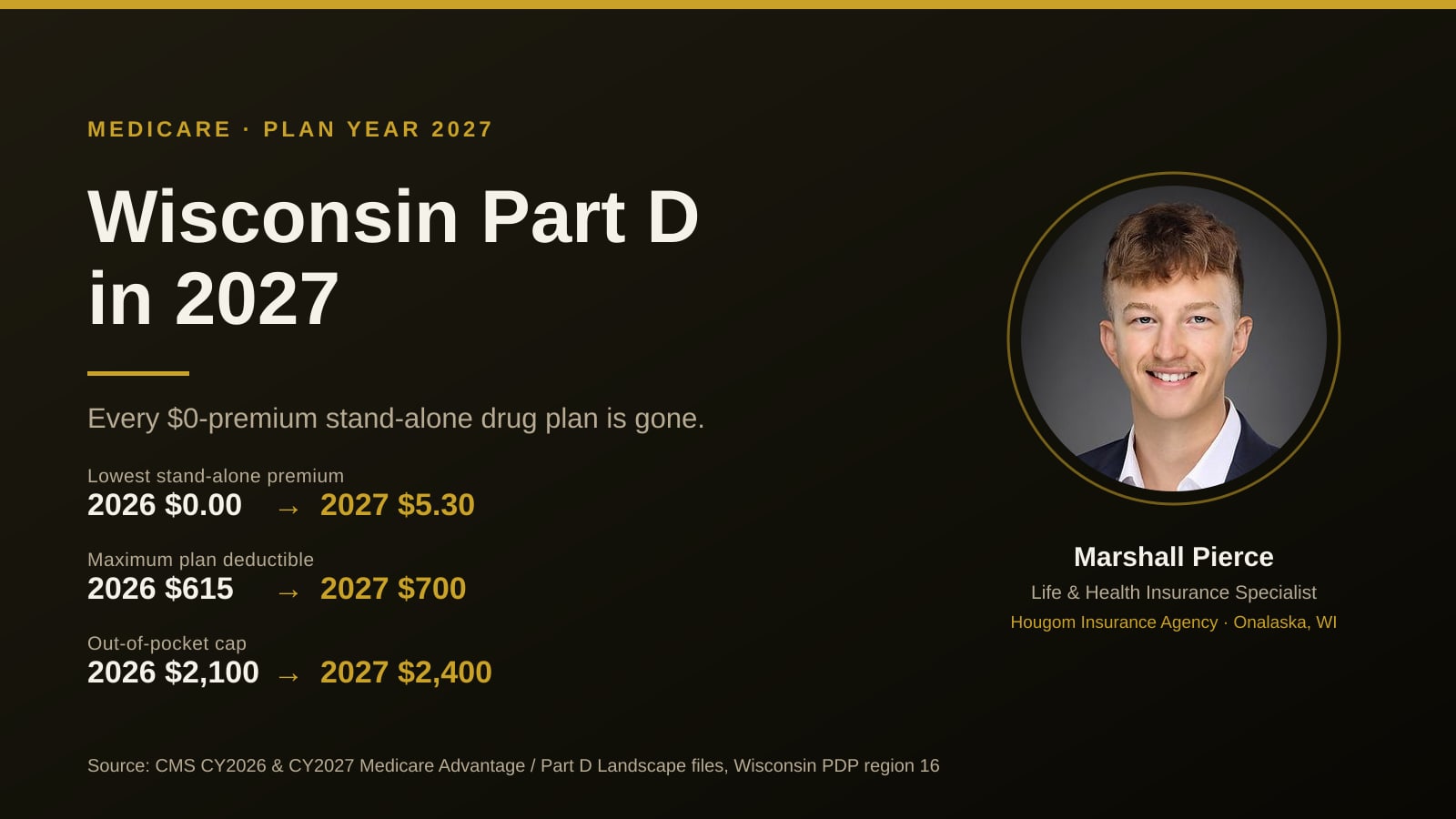
For plan year 2027, Wisconsin has eight stand-alone Medicare Part D plans and none of them has a $0 monthly premium. In the 2026 lineup, six of ten did. The least expensive stand-alone drug plan in the state for 2027 carries a total monthly premium of $5.30; the most expensive is $189.10. At the same time the federal ceiling on a Part D deductible rose from $615 to $700, and the annual out-of-pocket cap rose from $2,100 to $2,400. If you are on a Wisconsin drug plan that cost you nothing per month this year, your January premium will not be nothing — and the Annual Enrollment Period that runs October 15 through December 7 is the window in which you can do something about it.
TL;DR — Key takeaways
- Zero $0-premium stand-alone Part D plans in Wisconsin for 2027. Six of ten were $0.00 in the CY2026 CMS landscape file; the lowest of the eight 2027 plans is $5.30.
- Two plans left the Wisconsin market. SilverScript Choice and HealthSpring Extra Rx appear in the CY2026 file and not in the CY2027 file.
- Every remaining plan's deductible went up. The six plans that were at $615 or $601 moved to $700 or $687 — the new federal ceiling is $700 in 2027, up from $615 in 2026.
- The out-of-pocket cap rose to $2,400 for 2027, from $2,100 in 2026 — the point at which covered Part D drugs cost you nothing more that year.
- Extra Help recipients are affected too. The Wisconsin region's low-income premium subsidy fell from $21.12 to $6.27, and only one 2027 plan still shows a $0.00 low-income beneficiary premium.
- Doing nothing is a decision. Your plan renews at its 2027 terms. Your Annual Notice of Change was required at least 15 days before the enrollment period opens.
- The lowest premium is not automatically the lowest cost. Deductible, tier cost sharing, formulary and pharmacy network decide what you actually spend.
What changed in Wisconsin's Part D lineup?
Wisconsin is its own stand-alone Part D region — PDP region 16 — which means the same set of stand-alone drug plans is offered statewide, from Superior to Kenosha, and the La Crosse area sees exactly what Milwaukee sees. That makes the year-over-year comparison unusually clean: there is one lineup to compare, not seventy-two county lineups.
Comparing the CMS CY2026 landscape file with the first CY2027 release produces three findings.
- The count fell from ten plans to eight. Two plans that were offered in Wisconsin for 2026 do not appear in the 2027 file: SilverScript Choice, which carried a $26.70 monthly premium, and HealthSpring Extra Rx, at $56.30.
- The $0 tier disappeared entirely. Six of the ten 2026 plans had a total monthly premium of $0.00. For 2027, the lowest total monthly premium in the state is $5.30, and the next four cluster between $6.30 and $11.40.
- Deductibles rose across the board. Not one plan in the 2027 lineup has a lower deductible than its 2026 counterpart. Six sit at the new federal ceiling of $700 or just under it at $687. The two plans that had used a low deductible as a selling point — Humana Premier Rx at $0 and AARP Medicare Rx Preferred at $130 — moved to $350 and $300.
A note on what this is and is not. These eight rows describe stand-alone Part D plans — the kind you add to Original Medicare or to a Wisconsin Medicare Supplement policy, which never includes drug coverage. They say nothing about the drug coverage bundled inside a Medicare Advantage plan, which is priced per county and shows up in a different part of the same CMS file. If you are on a Medicare Advantage plan with drug coverage, your 2027 numbers are a separate question and your own Annual Notice of Change is the place to start.
Wisconsin stand-alone Part D plans, 2027: total monthly premium
Source: CMS Medicare Advantage / Part D Landscape source file, CY2027 (first release), Wisconsin PDP region 16, all eight stand-alone Part D rows. Figures are the published total monthly Part D premium for plan year 2027. Premium alone does not determine your cost — see the deductible, formulary and pharmacy network discussion below. Not a quote, not a recommendation, and not every plan available in your area.
Every Wisconsin stand-alone plan, 2026 next to 2027
Here is the whole lineup, both years, as CMS publishes it. The 2026 column is the CY2026 landscape file; the 2027 column is the first CY2027 release. Plans are ordered by their 2027 premium, with the two departing plans at the bottom.
| Plan | 2026 premium | 2027 premium | 2026 deductible | 2027 deductible |
|---|---|---|---|---|
| Wellcare Value Script | $0.00 | $5.30 | $615 | $700 |
| Humana Basic Rx | $0.00 | $6.30 | $615 | $700 |
| Wellcare Classic | $0.00 | $7.30 | $615 | $700 |
| AARP Medicare Rx Saver | $0.00 | $10.30 | $615 | $700 |
| HealthSpring Assurance Rx | $0.00 | $11.40 | $615 | $700 |
| Humana Value Rx | $0.00 | $22.30 | $601 | $687 |
| Humana Premier Rx | $110.60 | $129.90 | $0 | $350 |
| AARP Medicare Rx Preferred | $113.90 | $189.10 | $130 | $300 |
| SilverScript Choice | $26.70 | Not offered | $615 | — |
| HealthSpring Extra Rx | $56.30 | Not offered | $615 | — |
Source: CMS Medicare Advantage / Part D Landscape source files, CY2026 and CY2027, Wisconsin PDP region 16. Listing a plan is not an endorsement or a recommendation of it, and this table does not represent every plan available in your area. One structural note worth flagging: HealthSpring Assurance Rx appears under a different CMS contract number in the 2027 file than in the 2026 file, marketed under a Blue Cross and Blue Shield name, though both contracts sit under the same parent organization. If you are enrolled in it, read your Annual Notice of Change rather than assuming the plan is unchanged.
The honest caveat about this table. It compares two of the four things that decide what a drug plan costs you. It does not show tier cost sharing, and it does not show formularies or pharmacy networks — which, for most people taking brand-name medications, matter more than the premium does. A $5.30 plan that excludes one of your drugs is more expensive than a $22.30 plan that covers all of them. Treat the table as the starting point of a comparison, not the end of one.
The three federal numbers that moved for 2027
Two of the changes above are not Wisconsin-specific at all. They are federal parameters that reset every year and apply to every Part D plan in the country.
| Parameter | 2026 | 2027 | What it means |
|---|---|---|---|
| Maximum plan deductible | $615 | $700 | A ceiling, not a requirement. No Medicare drug plan may charge more; plans may charge less, and some do. |
| Annual out-of-pocket threshold | $2,100 | $2,400 | Once your out-of-pocket spending on covered Part D drugs reaches it, covered drugs cost you nothing more for the rest of the calendar year. |
| National base beneficiary premium | $38.99 | Not yet published | The figure the late enrollment penalty is calculated against. CMS had not published the 2027 amount as of this writing. |
Source: Medicare.gov, "Costs for Medicare drug coverage." The $700 and $2,400 figures also appear on every Wisconsin row of the CMS CY2027 landscape file, and the $615 and $2,100 figures on every Wisconsin row of the CY2026 file.
The deductible ceiling matters more this year than it usually does, because so many Wisconsin plans sit right at it. In 2026, six of the ten plans used a $615 or $601 deductible; for 2027, those same six moved to $700 or $687. For someone whose drug spending lands in the first few hundred dollars of the year, that is a straightforward increase of about $85 before anything else changes.
The out-of-pocket cap moving from $2,100 to $2,400 cuts the other way for a small number of people and barely registers for most. If you take expensive specialty medications and reliably hit the cap, you will now pay up to $300 more before you get there. If you take two generics, you will never approach it, and the number is irrelevant to you. It is worth knowing which of those two people you are before you read any further into it.
What happens if you do nothing
You stay enrolled. That is the whole mechanism, and it is why this year's change is easy to miss.
Part D plans renew automatically. If you were on one of the six Wisconsin plans that cost $0.00 a month in 2026 and you take no action between October 15 and December 7, you will be on that same plan in January at its 2027 premium — somewhere between $5.30 and $22.30 a month depending on which one — with a deductible that has risen to $700 or $687. Nobody will call you. The money will simply come out of your Social Security check, or arrive as a bill, starting in January.
You were, however, told. Under 42 CFR § 423.128(g)(2), a Part D sponsor changing its rules effective January 1 must "notify all enrollees at least 15 days before the beginning of the Annual Coordinated Election Period." Since that period opens October 15, the notice is due by the end of September. It arrives as the Annual Notice of Change, usually in a thick envelope alongside the Evidence of Coverage, and it is the single most useful piece of mail you will get this fall.
Find that envelope. If you have thrown it out, the plan will send another copy, and the 2027 details are also on the plan's own website and in the Medicare Plan Finder at Medicare.gov. What you are looking for in it: the 2027 monthly premium, the 2027 deductible, whether any of your drugs moved tiers or came off the formulary, and whether your pharmacy is still in the preferred network. Those four answers decide whether you should switch.
If you get Extra Help, read this part
Extra Help — the Part D Low-Income Subsidy — pays part or all of your drug plan premium, and the amount it pays is capped at a benchmark figure set regionally each year. For Wisconsin, that benchmark moved sharply.
Wisconsin region low-income premium subsidy amount, 2026 vs. 2027
Source: CMS Medicare Advantage / Part D Landscape source files, CY2026 and CY2027, low-income premium subsidy amount published on every Wisconsin PDP region 16 row. This is the monthly regional subsidy amount applied to a plan's basic premium — not a figure for any individual's total drug costs.
The practical consequence shows up in the per-plan low-income beneficiary premium CMS publishes alongside it. In the 2027 Wisconsin lineup, that figure is $0.00 on Humana Basic Rx and $1.00 on Wellcare Classic. On the other six plans it ranges from $4.00 to $182.80 a month for someone receiving the full subsidy.
In other words, a person with Extra Help who was in any of several $0 plans in 2026 may now be in a plan that costs them a monthly premium, even with the subsidy applied — because their plan's basic premium rose above the regional benchmark and the subsidy no longer covers all of it. This is the group most likely to be caught out, and least likely to be watching for it.
If this is you: read the notices Medicare mails in the fall about your Extra Help and your plan's standing, confirm your 2027 plan's low-income premium specifically rather than its headline premium, and if the number has moved, compare before December 7. Your local State Health Insurance Assistance Program counselor or county benefit specialist can help at no charge, and so can a licensed agent.
Wisconsin SeniorCare sits beside Part D, not instead of it
Wisconsin runs a state prescription drug assistance program that people in most other states do not have, and it is routinely left out of Part D conversations. SeniorCare is administered by the Wisconsin Department of Health Services for state residents aged 65 and older. DHS states the enrollment fee is $30 per person per year, and that in 2025 more than 91,000 people received services under SeniorCare each month.
Crucially, DHS states that "SeniorCare will coordinate coverage with your other insurance. That includes Medicare Part B or D." The two are not mutually exclusive, and the right answer for a given household depends on income and drug list together.
What you pay under SeniorCare depends on which of four annual income levels you fall into. DHS publishes these for 2026:
| Level | Individual | Couple |
|---|---|---|
| Level 1 | $25,536 | $34,624 |
| Level 2A | $25,537–$31,920 | $34,625–$43,280 |
| Level 2B | $31,921–$38,304 | $43,281–$51,936 |
| Level 3 | $38,305 or more | $51,937 or more |
Source: Wisconsin Department of Health Services, "SeniorCare: Annual Income Limits," stated on the page as the limits for 2026.
Levels 2A, 2B and 3 each pay a deductible each year for covered prescription drugs before reaching the copay level. For Level 3, DHS states the member first meets a spenddown — "the difference between your gross annual income and 240% of the current federal poverty level" — and then an $850 deductible per person. At the copay level, DHS states the amounts are $5 for each covered generic drug, $15 for each covered brand-name drug, and $0 for vaccines. The deductible amounts that apply at Levels 2A and 2B are set out on the DHS fact sheet and are lower than the Level 3 figure; confirm your own level with DHS or a benefit specialist rather than assuming.
Why this belongs in a Part D article. SeniorCare does not, by itself, protect you from the Part D late enrollment penalty question, and it is not a substitute for creditable coverage in every circumstance. That makes "should I have SeniorCare, a Part D plan, or both?" a real question with a real wrong answer — and one worth working through with a licensed agent or a SHIP counselor before December 7, not after.
The late enrollment penalty, and why premiums rising makes it tempting
When premiums go up, some people who take no medications conclude that a drug plan is money wasted and drop it. That decision has a long tail.
Medicare.gov states the calculation plainly: the Part D late enrollment penalty is "1% times the 'national base beneficiary premium' ($38.99 in 2026) times the number of full, uncovered months" you went without creditable prescription drug coverage after first becoming eligible. Because the penalty is recalculated against that national figure each year, the dollar amount moves as the figure moves, and it generally stays with you for as long as you have Part D.
Run that out. Thirty-six uncovered months is 36% of the base beneficiary premium, added to whatever your plan charges, for as long as you keep drug coverage. The arithmetic is not dramatic in any single month, which is exactly why it is easy to accept and hard to undo.
There is a reasonable version of the same instinct: if your medications are few and inexpensive, move to a lower-premium plan rather than to no plan. For 2027 that is a choice among eight stand-alone options in Wisconsin, five of which are under $12 a month. Dropping coverage entirely is a different decision with a different consequence.
Your enrollment windows — and the narrower ones after
The Annual Enrollment Period is the general-purpose window. After it closes, your options narrow considerably, and the rules that govern them are specific.
| Window | Dates | What you can do | Authority |
|---|---|---|---|
| Annual coordinated election period (AEP) | October 15 – December 7 | Join, switch or drop a Part D plan; change between Original Medicare and Medicare Advantage. Coverage starts January 1. | 42 CFR § 423.38(b)(3) |
| Medicare Advantage open enrollment | First three months of the year | If you are already enrolled in an MA plan, one election to move to another MA plan or return to Original Medicare. Not a general Part D shopping window. | 42 CFR § 422.62(a)(3)(i) |
| 5-star plan special enrollment period | December 8 through November 30 of the contract year | Move into a plan carrying a 5-star overall performance rating. Usable once for that contract year. | 42 CFR § 423.38(c)(20) |
Other special enrollment periods exist for specific circumstances — moving out of a plan's service area, losing other creditable coverage, entering or leaving an institution, and more. They are fact-specific; confirm your own at Medicare.gov or 1-800-MEDICARE.
One detail about the 5-star window is worth knowing this particular year. Star ratings for contract year 2027 are not published in the first CY2027 landscape release — they arrive with the CMS October Star Ratings release. That means no 2027 star rating is quoted anywhere in this article, and that anyone planning around the 5-star special enrollment period should check current ratings at Medicare.gov rather than carrying a prior year's rating forward.
A six-step review before December 7
This is the sequence that actually answers the question, in the order that saves the most time.
- Find your Annual Notice of Change. Your plan was required to send it at least 15 days before October 15. Read the 2027 premium and the 2027 deductible first.
- Write down your drug list exactly. Every medication, the dose, and the quantity you fill. Approximations produce approximate answers, and the whole exercise turns on this list.
- Write down your pharmacy. Preferred-network status changes year to year and moves your cost sharing materially even when nothing about the plan's headline numbers changed.
- Check whether each drug is still on the 2027 formulary, and at what tier. A drug moving from tier 2 to tier 3, or off the list entirely, is a bigger cost event than a $5 premium change.
- Price your actual list against the alternatives. The Medicare Plan Finder will total premium, deductible and estimated drug costs for the full year for each plan. That total — not the premium — is the number to compare.
- If you have Extra Help or SeniorCare, check those separately. Confirm the low-income premium on your 2027 plan, and confirm your SeniorCare level if you are enrolled. Neither is reflected in the headline premium.
If that sounds like an evening's work, it is — but it is an evening that happens once a year and that this year has an unusually clear reason to happen at all.
Want a second set of eyes on your 2027 drug plan? We will run your drug list and your pharmacy against the plans we offer and show you the full-year cost comparison, not just the premium. Call Hougom Insurance Agency at (608) 799-8434 or request a review before December 7. There is no cost for the review. We do not offer every plan available in your area.
Frequently asked questions
Did Wisconsin really lose every $0-premium stand-alone Part D plan for 2027?
Yes, for stand-alone drug plans. In the CMS CY2026 landscape file, six of the ten stand-alone Part D plans available statewide in Wisconsin carried a total monthly premium of $0.00. In the first CY2027 landscape release, Wisconsin has eight stand-alone plans and the lowest total monthly premium among them is $5.30, on Wellcare Value Script. None is at $0.00. This applies to stand-alone Part D plans — the kind you pair with Original Medicare or a Wisconsin Medicare Supplement policy. It does not say anything about drug coverage built into a Medicare Advantage plan, which is priced separately and is not what these eight rows describe.
What are the Part D deductible and out-of-pocket cap for 2027?
Medicare.gov states that no Medicare drug plan may have a deductible of more than $700 in 2027, up from $615 in 2026, and that the annual out-of-pocket spending threshold on covered Part D drugs is $2,400 in 2027, up from $2,100 in 2026. Both figures match what appears on every Wisconsin row of the CMS CY2027 landscape file. The $700 is a ceiling, not a required amount — a plan may charge less, and in the 2027 Wisconsin lineup two plans do: Humana Premier Rx at $350 and AARP Medicare Rx Preferred at $300. The $2,400 is the point at which you stop paying for covered Part D drugs for the rest of the calendar year.
What happens if I do nothing during the Annual Enrollment Period?
In almost every case you stay in your current plan and it renews with its 2027 premium, deductible, formulary and pharmacy network. Nothing cancels automatically. That is precisely the risk this year: a Wisconsin plan that cost you $0.00 a month in 2026 will keep you enrolled in 2027 at a premium that is no longer $0.00, and with a deductible that has risen by about $85. Your plan was required to tell you in writing — under 42 CFR § 423.128(g)(2), the sponsor must notify every enrollee of January 1 changes at least 15 days before the annual coordinated election period begins. That notice is the Annual Notice of Change, and it is the document to find before you decide.
I get Extra Help. Does any of this affect me?
It may, and this is the part most easily missed. The low-income premium subsidy amount published for the Wisconsin PDP region fell from $21.12 in the CY2026 landscape file to $6.27 in the CY2027 file. The subsidy covers the plan's basic premium up to that regional amount; anything above it is yours to pay. In the CY2027 Wisconsin rows, the published low-income beneficiary premium is $0.00 on Humana Basic Rx and $1.00 on Wellcare Classic, while the other six plans range from $4.00 to $182.80 a month for someone receiving the full subsidy. If you have Extra Help and you stay where you are without checking, you can end up paying a premium you did not pay last year. Review the Extra Help notices Medicare sends in the fall and confirm your 2027 plan's low-income premium before December 7.
Should I just pick the plan with the lowest premium?
No, and the premium table in this article is deliberately not a recommendation. A stand-alone drug plan has four cost levers that interact: the monthly premium, the annual deductible, the cost sharing on each tier, and whether your particular drugs are on the formulary at all and your pharmacy is in the preferred network. A plan with a $5.30 premium and a $700 deductible can easily cost more over a year than one with a $22.30 premium and a $687 deductible, depending entirely on which medications you take and where you fill them. The only way to answer it is to price your actual drug list, at your actual pharmacy, against each plan — which is what the Medicare Plan Finder at Medicare.gov does, and what a licensed agent should do with you.
Can I change my drug plan after December 7?
Sometimes, under a narrower set of rules. Under 42 CFR § 423.38(b)(3), the annual coordinated election period for the following calendar year is October 15 through December 7 — that is the general window. After it closes, a separate rule at 42 CFR § 422.62(a)(3)(i) lets someone already enrolled in a Medicare Advantage plan make one election during the first three months of the year to move to another MA plan or return to Original Medicare. There is also a special enrollment period at 42 CFR § 423.38(c)(20) to move into a plan carrying a 5-star overall performance rating, usable once for that contract year, from the December 8 before the contract year through November 30 of it. Other special enrollment periods exist for specific life events. None of these is a general right to shop in February, so the December 7 date is the one to work to.
What is the Part D late enrollment penalty, and how is it calculated?
It is a permanent amount added to your monthly Part D premium if you went without creditable prescription drug coverage after you were first eligible. Medicare.gov states the calculation: 1% times the national base beneficiary premium, which was $38.99 in 2026, times the number of full uncovered months. Because the penalty is recalculated against the national base beneficiary premium each year, the dollar amount moves as that figure moves, and it generally continues for as long as you have Part D. The practical point is that it is driven by months without creditable coverage, not by which plan you choose — so dropping drug coverage because you take no medications is the decision that creates it.
What is Wisconsin SeniorCare, and can I have it alongside Part D?
SeniorCare is Wisconsin's own prescription drug assistance program for state residents age 65 and older, run by the Department of Health Services. The enrollment fee is $30 per person per year, and DHS states that more than 91,000 people received services under SeniorCare each month in 2025. DHS also states that SeniorCare coordinates coverage with your other insurance, including Medicare Part B or D, so the two are not mutually exclusive. What you pay under SeniorCare depends on which of four annual income levels you fall into, with a spenddown and then a deductible at the higher levels before you reach the copay level. Whether SeniorCare, a Part D plan, or both makes sense is a question worth putting to a licensed agent or to your local SHIP counselor, because it turns on your income and your drug list together.
Sources
- Centers for Medicare & Medicaid Services. Medicare Advantage / Part D Landscape Source Files — CY2027 (first release) and CY2026, Wisconsin stand-alone Part D rows, PDP region 16. Plan names, total monthly premiums, annual deductibles, low-income premium subsidy amounts, low-income beneficiary premiums and out-of-pocket thresholds in this article are read from these files. cms.gov
- Centers for Medicare & Medicaid Services. Costs for Medicare drug coverage — maximum plan deductible ($700 in 2027, $615 in 2026), annual out-of-pocket threshold ($2,400 in 2027, $2,100 in 2026), and the late enrollment penalty formula with the 2026 national base beneficiary premium of $38.99. medicare.gov
- Code of Federal Regulations. 42 CFR § 423.38 — Enrollment periods (see (b)(3) for the October 15 – December 7 annual coordinated election period and (c)(20) for the 5-star special enrollment period). ecfr.gov
- Code of Federal Regulations. 42 CFR § 423.128 — Dissemination of Part D plan information (see (g)(2) for the Annual Notice of Change deadline). ecfr.gov
- Code of Federal Regulations. 42 CFR § 422.62 — Election of coverage under an MA plan (see (a)(3)(i) for the first-three-months election). ecfr.gov
- Wisconsin Department of Health Services. SeniorCare — eligibility, the $30 annual enrollment fee, coordination with Medicare Part B or D, and 2025 monthly enrollment. dhs.wisconsin.gov
- Wisconsin Department of Health Services. SeniorCare: Annual Income Limits — the 2026 Level 1, 2A, 2B and 3 income limits for individuals and couples. dhs.wisconsin.gov
- Wisconsin Department of Health Services. SeniorCare: Understanding How Spenddowns and Deductibles Work — the Level 3 spenddown definition, the $850 deductible, and the $5 / $15 / $0 copay level. dhs.wisconsin.gov
Compliance disclosures: We do not offer every plan available in your area. Any information we provide is limited to those plans we do offer in your area. Please contact Medicare.gov, 1-800-MEDICARE, or your local State Health Insurance Assistance Program (SHIP) to get information on all of your options. Not affiliated with or endorsed by the U.S. government or the federal Medicare program. This article is for general information only and is not medical, insurance, tax, or legal advice. It is education about how plan year 2027 figures changed, not a recommendation of any plan, carrier, or course of action. Plan year 2027 figures are used throughout except where a 2026 figure is labeled as such; the 2027 national base beneficiary premium and the 2027 Part B premium had not been published by CMS as of October 5, 2026 and no figure for either appears above. Contract year 2027 star ratings are not included in the first CY2027 landscape release and no 2027 star rating is quoted. Premiums, deductibles, formularies, pharmacy networks, plan availability and federal parameters change, and a plan's published premium is not a quote for you; confirm current details at Medicare.gov or 1-800-MEDICARE and review your own Annual Notice of Change. Eligibility and benefits under Wisconsin SeniorCare are determined by the Wisconsin Department of Health Services, not by this agency. Hougom Insurance Agency is a licensed independent insurance agency (NPN 20742808).